Tuesday, 24 June 2014
CALIFORNICATION MUSIC VIDEO - FINAL
Here is our final music video - Californication by the Red Hot Chilli Peppers - the video on Youtube was taken down due to copyright, therefore I uploaded it on Vimeo.

Tuesday, 8 April 2014
Welcome Moderator to my A2 Media Studies Blog!
The below posts contain: My music promotional video, magazine advert and thealbum artwork (digipak). The posts below will visually show my thought processes as the product developed from the initial idea, to final products. My evaluation questionsare on 4 separate pageswhich can be easily seen at the top of my Blog.
Ellyn Walton 9184
Claremont Fan Court School: 64680
OCR A2 Media Studies
April 2014
Video Brief:
To create a music video along with its ancillary products.
Sunday, 6 April 2014
FINAL PRODUCT - CALIFORNICATION MUSIC VIDEO
Here is our finished music video - Californication by The Red Hot Chilli Peppers.
Please click play on the embedded video or CLICK HERE.
Saturday, 5 April 2014


Friday, 28 March 2014
Tuesday, 18 March 2014
CONSTRUCTION: MUSIC VIDEO EDITING


In todays lesson, Elliot, Max and I decided
to focus on editing more of our music video, using iMovie. We discussed which
order we would put the different scenes in – which will eventually show the
stereotypical view of life in California. This view includes the American and Hollywood obsession with product and materialism that is referred to in the lyrics of the song. The stereotypical aspects also consist of people splashing out on all the latest popular fashion items and expensive treatments, such as Botox and plastic surgery, in order to give them the ideal 'perfect' image.
Besides this, we also had the challenge of editing the Californication track in so it was in perfect timing with the lip-syncing of Max, who is the main singer in our video. It is important to get this key convention of lip-synching spot on as we want to make it look like Max is actually singing. If the lip-synching wasn't in time with the sound track it would look extremely unprofessional and would make it obvious that he isn't actually singing.
PLANNING: TRELLO

I began to use the website Trello to create a to-do list associating with my media work.
Trello allows you to make make lists that are labelled 'to do', 'doing', and 'done'. This is very useful for planning and organising my activities as it helps me to keep on top of my work.
Wednesday, 5 March 2014
PLANNING: DIGIPACK DESIGN
During today's lesson we began designing our Digipack for our Californication music video. We began focusing on the front cover of the album - therefore, we went through all of our filming to date, as well as stills to find original images suitable for the front cover of our digipack. On a piece of filming where the film scrolls across a wall with the words 'CALIFORNIA' gratified on it, we decided that this would be appropriate for our front cover as we would have the CALIFORNIA in graffiti in the centre of the digipack and above and below the CALIFORNIA graffiti we would use other images and designs suitable for the front of the digipack.
However, as the wall only has 'CALIFORNIA' written on it, it was my task to use photoshop to add the rest of 'Californication' onto the original word. I did this by copy and pasting the letters from the original photo, which were needed, and carefully placed them in the right place as well as making sure they were the right size.
Max began designing something else to add to our digipack. He took the shape of California on the map, coloured it in red, using the program Paint and added a green stem to it, to make it look like a chilli pepper, after the Red Hot Chilli Peppers. This was a very unique idea, that provides something different to our digipack. We haven't yet decided where this is going to go yet on our digipack.
Friday, 7 February 2014

Friday, 17 January 2014
CONSTRUCTION: FLIPAGRAM
 |
| Flipagram |
 For our latest shoot, which involved us taking many shots of the group wearing snapback hats at different angles, we used the new app Flipagram, to make a stop motion video of all the shots that were taken.
Flipagram allows you to add as many photos as you like to the video, as well as editing how long each transition is.
A music feature is also available for background sounds, and you can chose from a wide range of tracks, old and new, to play in the background - although these are only 30 seconds long and to use the full track you must pay the usual purchase price with ranges from 79p-99p.

Here is an example of the stop motion video we made using Flipagram for our music video - Californication.
CONSTRUCTION: EDITING SNAPBACK PHOTOS
In today's lesson we made use of the photos of the snap-back scene that we took on Tuesday afternoon.
We began by selecting all the best photos from our various shoots and cropping them all down to the same size, making sure to cut out any unnecessary background. These pictures will form a montage in our music video so it is important that they are all the same relative size.
After they had been cropped we put the images into photo-shop to be layered and defined to bring out better colour contrast and lighting effects. The end results have been put into a flipagram slideshow.
Thursday, 16 January 2014
CONSTRUCTION: SNAPBACK SCENE
On Tuesday 14th January, Elliot, Max, and I went to Esher and location scouted for possible places to shoot our snapback scene.
The idea behind this shoot was to emphasise the American and Hollywood obsession with product and materialism that is referred to in the lyrics of Californication. This ties in with Adorno's theory of a culture industry that is designed to feed the general population petty materials and products to keep them happy and brain-dead.
After location scouting, we now had three locations that were ideal for the scene - a small common, a private road and against an all white wall. The shoot consist of us three standing in different locations in a profile position. To represent the materialism we decided to use snap-back hats because they are currently a very popular fashion item and are quite an expensive item of clothing that is not a necessity. The scene features us all wearing these snap-backs, but in every photo the position of the hat will change while we remain still. The photos will form a montage in our video to represent the materialism of Californication.


Wednesday, 15 January 2014
PLANNING: FACEBOOK PAGE
Today Max, Elliot and I created a Facebook page in order to update our friends and peers with the process of creating our music video and designing our digipak.
Using a popular social media site such as Facebook, really enables us to get lots of feedback from friends and peers, and the page encourages them to leave a comment if necessary. It is especially helpful to gain feedback from friends and peers seeing as they are in the targeted audience age range for our music video, which is 16-24.


Tuesday, 14 January 2014
Monday, 2 December 2013
CONSTRUCTION: BAND SCENE FILMING
On the 19th November, Elliot, Max and I booked to use the school gym after school for a couple of hours to start shooting some of the band scenes for our music video. As the gym was fairly big, with lots of empty space, this allowed us to experiment with all the lighting, and a couple of cameras at different angles and view points. The large amount of space we were able to work with made the use of props (drum kit, which was booked in advance) much easier to use and move around.

The photo above shows the set up for our shoot, and how all the lighting and cameras were placed to focus on the drum kit which was seen as the object in the film shots. We had to use tape to mark on the floor where each guitarist would stand, so they would be in the frame for each camera, which were at different angles.

Here is an image of the Go-Pro we used in order to get close up shots of the instruments and the finger movements on the guitars. We only used this Go-Pro for the guitars. It was really useful because you could link the Go-Pro up to an iPhone and see the imagery on the iPhone whilst filming so you knew what the quality and positioning was like. This was simple and easy to do and therefore only took a few minutes to get around 30 seconds of video recorded. We held the Go-Pro in place because if we used the 'sticky mount' it would have been hard to move the Go-Pro from guitar to guitar. Huw simply held the camera in place and we adjusted the angle to get different shots.

This photo shows Elliot and Max on set, when we decided to try out the smoke machine which our teacher was able to get for us. We used this to add depth to our lighting when filming to create some very dark and creative band-like shots. The fact that we could utilise the large gym meant the smoke spread quickly and evenly so we were not completely hidden in smoke whilst on camera.
Overall, the shoot went extremely well, even though it faced several challenges in terms of lighting, the smoke machine and framing, which we all managed to tackle sensibly. And although we were time pressured due to a late start because of the lack of availability of the school gym until 4pm, we got a lot of brilliant work done with these shots we have taken, providing us with near a minutes worth of filming for our music video. We will review what we have filmed on Thursday 20th November and begin to start editing the shots so that they are ready to be incorporated in the music video, when new scenes are filmed.
Tuesday, 19 November 2013
CONSTRUCTION: FIRST SCENE SHOOT
Today, Elliot, Max and I filmed one of the first scenes for our music video.
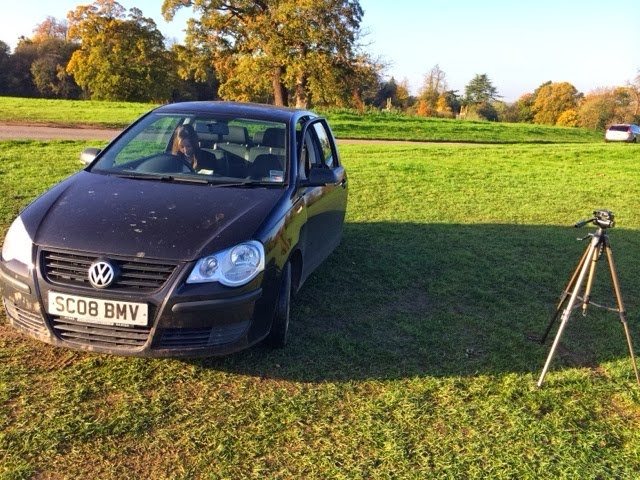 The scene shows myself driving into the distance, followed by a tracking and zooming shot. As the car gets further away from the camera, Elliot (sitting in the passenger seat) carelessly throws a handful of money out the window.
 Here is a picture of the tripod and the car we were using during the filming of our first shoot - which was the money throwing out the window scene. The weather was sunny and crisp and therefore it was an ideal time to film this scene as we could see everything clearly when filming and reflected the Californian image.
We photocopied 5, 10 and 20 pound notes so that we could use something that looked realistic to throw out of the car window.
 We used a normal tripod to film the car and simply zoomed in and out to follow the car successfully rather than having to follow the car in order to get the shot we wanted, as that would have been hard to do and we may not have got a clear shot.
This scene is influenced directly by Adorno's Theory of the culture industry. Adorno suggested that today's society influences and encourages needless materialism and that people are kept satisfied by this need for things that are not actual necessity's, which has been manufactured by a huge
industry that churns out basic brain food to keep the human
population satisfied.
Bibliography:
Adorno, Theodor (1991), The Culture Industry: Selected essays on mass culture, Routledge, London.
Friday, 8 November 2013
PLANNING: CALL SHEET (GYM SCENE)
MUSIC VIDEO CALL SHEET – GYM SCENE
Track: Red Hot Chili Peppers – Californication
Length: 3 minutes 22 seconds
Location: Xcel Leisure Centre

Crew:
Ellie Walton
Crew:
Elliot Hogan
Camera
Equipment: - Nikon camera
-
Tripod
Props: -Lifting weights
-Headband
Wardrobe
Ellie
– Running leggings, running tank top, trainers (X2)
Elliot
– Vest top, shorts, trainers (X2)
PLANNING: DEFINITION OF CALIFORNICATION
DEFINITION OF CALIFORNICATION:
The process by which the American television and film industry, for the most part based in California, spreads their own highly sexualized, consumer driven, version of American culture that heavily emphasizes sex, violence, celebrity, and youth as both virtues to be extolled and goals to be achieved. Ignoring and often doing everything in their power to blur, if not erase, the dividing line between the fantasy of the cinemas world view and reality. This process has become pandemic with the proliferation of reality television wherein a person can achieve "Californication" without possessing any real talent but rather just the ability to make a fool of themselves on a world wide stage.
WEBSITE WHERE DEFINITION FOUND
Theodore Adorno has similar views to the creators of he song, Californication by the Red Hot Chili Peppers. Californication talks of the music and generation of today being fake, manufactured and purely for show instead of raw talent being expressed within the music industry.
Theodore Adorno (1991) says that these manufactured and "unsophisticated" products that replace critical art forms which then makes people forget about the important things such as the meaning of life and social interaction.
He also expresses the want for materialistic goods by todays generation and how image is seen as more important than anything else - similar to the lyrics of Californication.
Adorno (1903-69) argued that capitalism fed people with the products of a 'culture industry' - the opposite of 'true' art - to keep them passively satisfied and politically apathetic.
Adorno saw that capitalism had not become more precarious or close to collapse, as Marx had predicted. Instead, it had seemingly become more entrenched. Where Marx had focussed on economics, Adorno placed emphasis on the role ofculture in securing the status quo.
Popular culture was identified as the reason for people's passive satisfaction and lack of interest in overthrowing the capitalist system.
Adorno suggested that culture industries churn out a debased mass of unsophisticated, sentimental products which have replaced the more 'difficult' and critical art forms which might lead people to actuallyquestion social life.
False needs are cultivated in people by the culture industries. These are needs which can be both created and satisfied by the capitalist system, and which replace people's 'true' needs - freedom, full expression of human potential and creativity, genuine creative happiness.
Commodity fetishism (promoted by the marketing, advertising and media industries) means that social relations and cultural experiences are objectified in terms of money. We are delighted by something because of how much it cost.
Popular media and music products are characterised by standardisation (they are basically formulaic and similar) and pseudo-individualisation (incidental differences make them seem distinctive, but they're not).
Products of the culture industry may be emotional or apparently moving, but Adorno sees this as cathartic - we might seek some comfort in a sad film or song, have a bit of a cry, and then feel restored again.
Boiled down to its most obvious modern-day application, the argument would be that television leads people away from talking to each other or questioning the oppression in their lives. Instead they get up and go to work (if they are employed), come home and switch on TV, absorb TV's nonsense until bedtime, and then the daily cycle starts again.
- Adorno, Theodor W. (1991), The Culture Industry: Selected essays on mass culture, Routledge, London.
Thursday, 7 November 2013
PLANNING: CALL SHEET - MONEY THROWING SCENE
· Title of page: A2 Media Studies Call Sheet for Red Hot Chilli Peppers - Californication
· Length – 3 mins 22 seconds
· Shoot date – tbd
· Location – Money throwing out of car window – Ellie’s Car – in car

Crew: [Ellie Walton, elliepw@hotmail.co.uk,]
· Crew: [Elliot Hogan, hogan.elliot@yahoo.co.uk, 07825563046]
· Crew: [Max Day, maxday@hotmail.com]
· Camera equipment (Nikon Camera (Ellie’s cam) and tripod from media)
· Lighting equipment (N/A as will be done in natural daylight)
· Props (Photocopied money – preferably £20 notes)
· Wardrobe [Preferably American branded clothing to represent the Hollywood image]
Tuesday, 5 November 2013
PLANNING: SHOT SKETCHES

This was the preparatory work
for our storyboard for Californication. In our group of three, each of us
undertook one third of the drawing task by using Post It Notes. Underneath, you
can then see how I turned these Post It Notes into an animatic by using iMovie.
Subscribe to:
Posts (Atom)